
Local. Local. Local.
Three new plays set in Greater LA: "How High the Moon," "The People of Pompeii," "F**king Strangers." And brief notes on five other productions...
An obvious distinction of live theater is its immediacy — the audience is in the same room as the actors. For me, that sense increases even further when I’m in the same geographical area where the play is set — or at least fairly close. And it also intensifies when it’s occurring in a time frame that’s close to...right now.
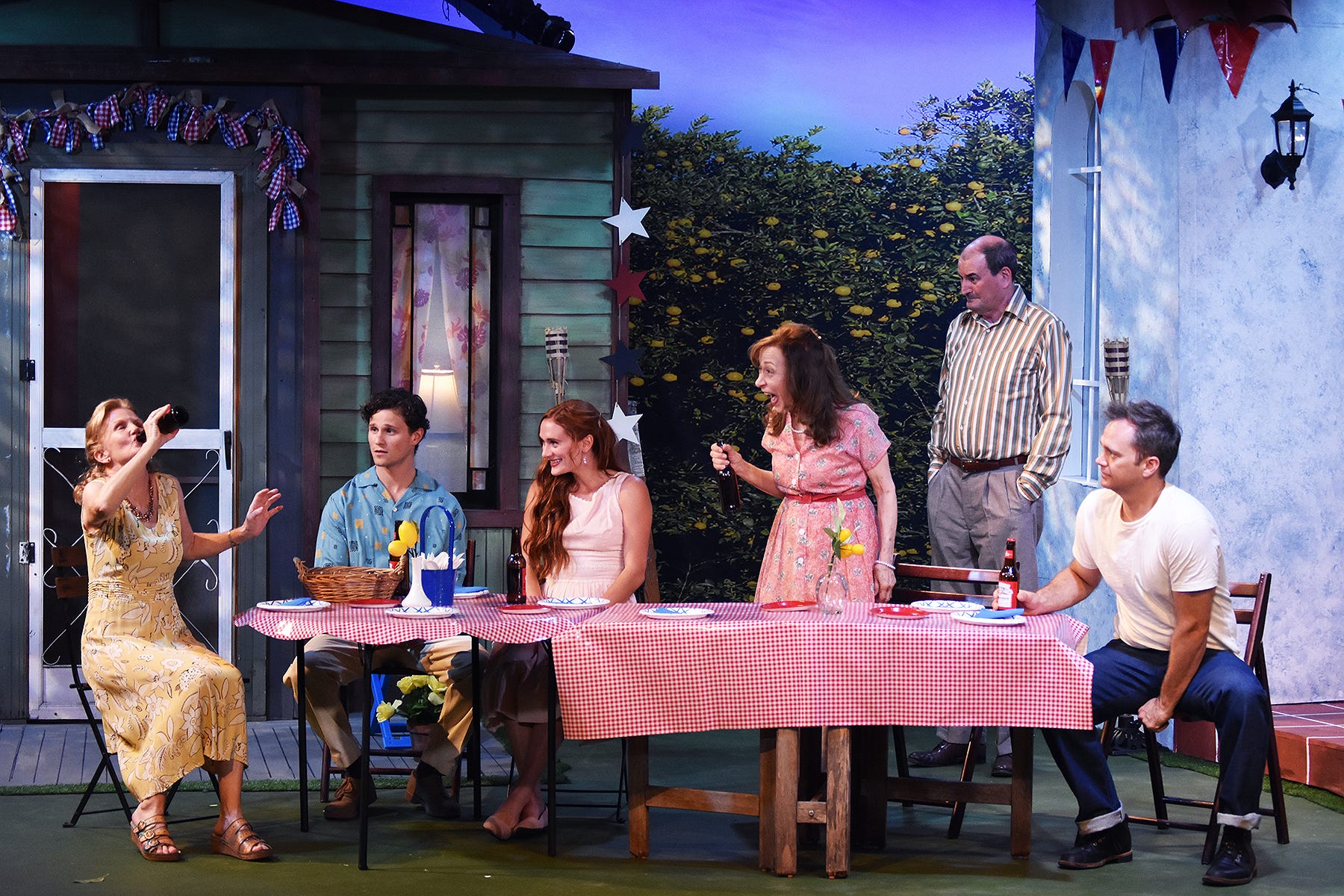
The maiden voyage of “How High the Moon” is taking place at Theatre West in the Cahuenga Pass — one of the major entrances to the San Fernando Valley, where it’s set. But when is it set? 1952.
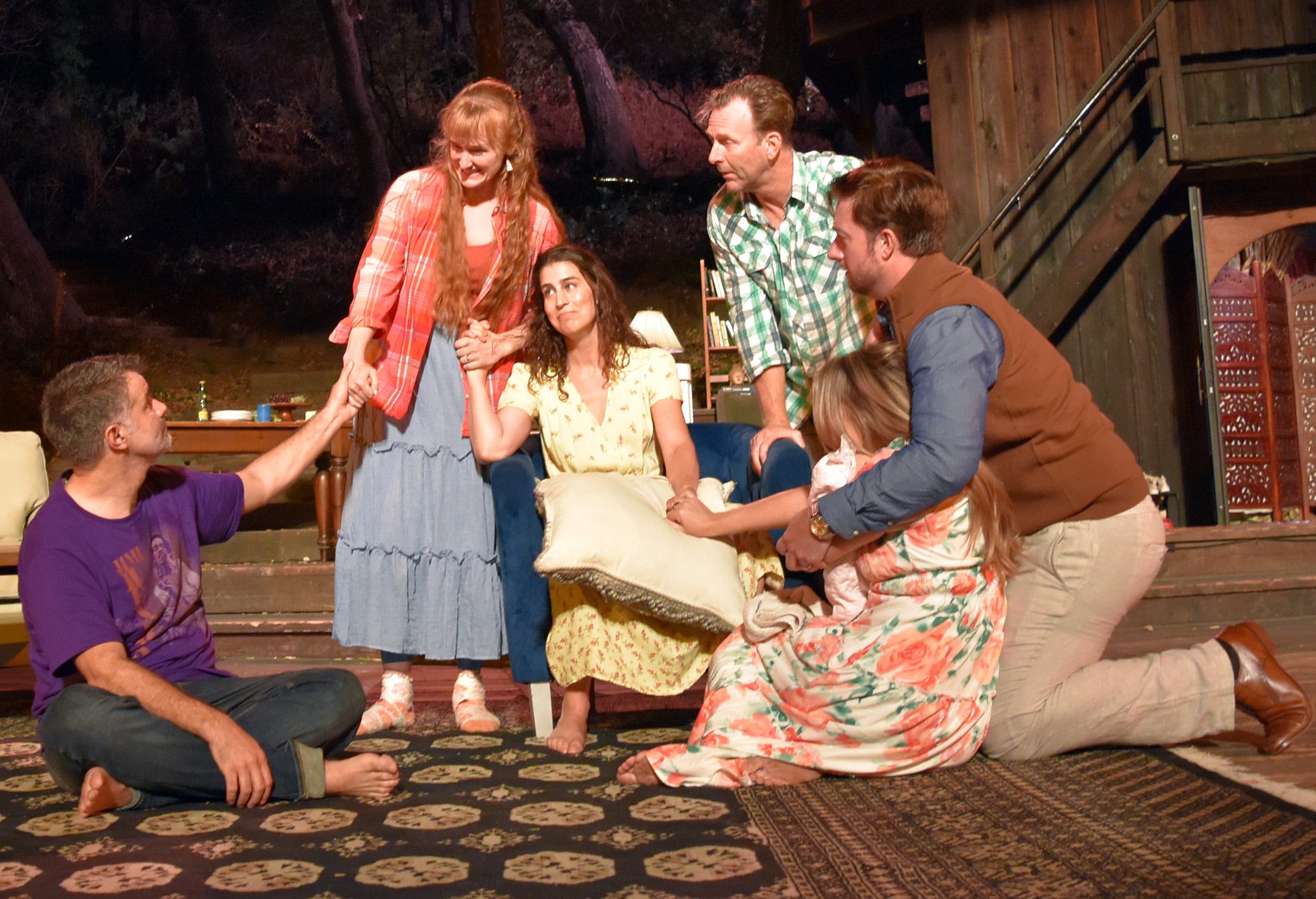
“The People of Pompeii” is not set in Pompeii. It’s set in Topanga, in the Santa Monica Mountains, and its premiere is on the primary stage of that community — the Theatricum Botanicum. The onstage action is happening only a year ago, in 2025.
Finally, “F**king Strangers” is set “now,” but it occurs in several locales — the majority of them in Orange County — about a hour’s drive from its first production, by Echo Theater in Atwater Village Theater in LA, just south of Glendale.
Let’s discuss this local trio, in the chronological order of when the plays are set.
“Van Nuys” is not “Van Nice”
You remember 1952? If you’re older even than I am, you might. Back then, according to Barbara Nell Beery’s script for “How High the Moon,” you could pick oranges in the grove behind your Van Nuys house — as a GM plant (the factory’s actual lifetime was 1947-1992) created smog in that same neighborhood. Also, the actual moon (the play’s title refers to a popular song that was first sung in 1940) probably seemed higher than it did less than two decades later, when human beings first landed on it.
In Beery’s play, two next-door-neighboring families in Van Nuys attempt to celebrate the 4th of July. But the youngest adult offspring of each of the families, who married each other but who lack a house of their own, are bickering. In fact, the young wife is moving from her in-laws’ house back into her mother’s. Then the unexpected holiday visit of a long-absent son/older brother (Lane Compton) who is a WWII vet now living in Berkeley, leads to some momentous drama.
Beery packs a lot of passion and surprises into her script. Asaad Kelada’s staging, Thomas Meleck’s set and Michael Mullen’s costumes at Theatre West accomplish almost as much as the script — and all of this lasts less than two hours.
It’s in Topanga, not ‘Pompeii’
If you think of Topanga’s Will Geer Theatricum Botanicum primarily as a place to enjoy classics in the great outdoors, think again. Its latest production introduces Bernardo Cubría’s “The People of Pompeii” — even though the play was commissioned by Old Globe Theatre in San Diego.
The play’s first production is much more at home in Topanga than it would be in San Diego (or in Pompeii — the Italian town that was wiped out by a volcano more than two centuries ago but now is best known as an archeological tourism site).
Cubría’s play is at least loosely inspired by the playwright’s experiences, after he and his wife Lauren Saffa moved to Topanga in the wake of the COVID crisis. Now the characters based on them (re-named Carlos and Vera) and played by them are hosting two other local couples — also in their 40s — at their home.
Their homes weren’t damaged during the nearby Palisades fire a few months earlier in 2025 — but who knows what will happen in the next fire, as the dangers rise along with the effects of climate change? In fact, though no one mentions the Theatricum itself, I began wondering about the venue’s own vulnerability to future fires.
But I might be misleading you about the nature of the play. Most of it is a comedy that reflects less on the fire next time than on the current relationships among these six forty-somethings — two of whom, we eventually learn, are about to leave Topanga. We also glimpse Carlos’ own feelings about being one of the few Mexican Americans in Topanga. The insular side of Topanga isn’t ignored. In fact, sometimes the script is so Topanga-specific that I’m not sure that it would play nearly as well anywhere else.
By the way, the cast includes two veteran Topangans — Theatricum co-producing artistic director Willow Geer and Theatricum veteran Aaron Hendry — as one of the couples. The production’s co-directors are Willow Geer’s mother and fellow co-producing artistic director Ellen Geer and Xochitl Romero.
Before we leave the Theatricum, I also should mention another play that joined its current repertory since my last post — Noel Coward’s “Waiting in the Wings,” directed by Willow Geer. This 1960 comedy takes us to a retirement home for English stage actresses. Susan Angelo plays a vibrant newcomer whose adult son maintains no contact. Ellen Geer is striking as the most demented of the women. But the production ends at just under three hours and could have been trimmed more tightly.
Footnote: in the original script, the most disgruntled woman is an Irish immigrant to the UK, Dierdre O’Malley. In this production, she becomes a self-identified American Black woman (veteran company member Earnestine Phillips) — but with the same Irish name, and with no explanation of how she ended up in this home.
Some ‘strangers’ aren’t all that strange
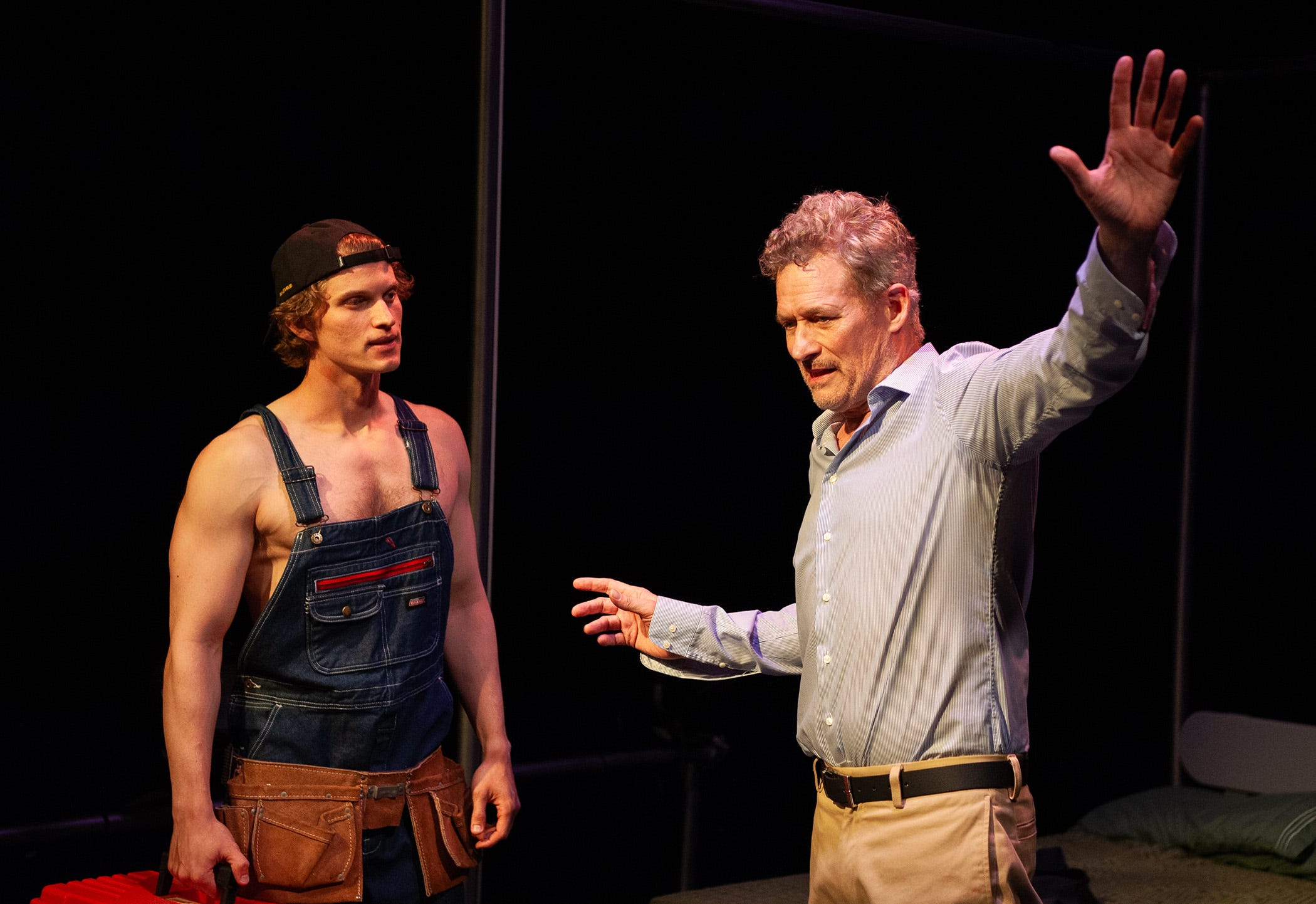
In Echo Theater’s premiere of Erik Patterson’s “F**king Strangers,” the echoes keep growing, as the characters seem less and less like “strangers.”
We soon discover that a middle-aged father (James Tupper) and his reclusive young-adult son (Michael Sturgis) each does recreational business, often on video, with the same sex worker (Sean Luc Rogers) — even as the father is still having sex with his wife (Tasha Ames). Meanwhile, she’s a massage therapist who never stops talking in her sessions with completely silent clients. She once wanted to be an actor and even trained at what sounds as if it might have been South Coast Repertory.
“F**king Strangers” gets a lot more more laughs than you might expect from the title. Some theatergoers might find its narrative a bit too intricate, but the ingenuity of the plot keeps bouncing around in my head, enhanced by wonderful performances from the entire quartet. The script’s variety of locations “should be represented in an impressionistic way, with the use of lighting and projections. The set should be sparse, use only what's necessary,” according to Patterson’s script. Director Chris Fields and company comply with understated assurance.
Also at the Echo, tonight, is one more performance — apparently sold out — of Ann Noble’s “Dead Man,” transferred from another venue where it first opened in the Hollywood Fringe Festival. It’s mostly a clownish but somewhat predictable parody of a detective story (Noble is also in the cast as a sexy blonde). Fortunately it ends on a somewhat more serious note.
Musicals, new and old
I regret that I couldn’t post while the musical “Mexodus” was still playing at Pasadena Playhouse. It closed Sunday. However, my reaction was mixed. The production featured interesting history (a US slave crosses to freedom in Mexico). But the live-looping tech by the two writers/actors, Brian Quijada and Nygel D. Robinson overloaded the stage, and the staging, and eventually became distracting.
However, if you’re in the mood for a more old-fashioned musical, “Applause” is still playing at Group Repertory in North Hollywood. This revival of the 1970 Comden/Green/Adams/Strouse adaptation of the “All About Eve” story features two excellent lead performances — Leslie Stevens’ Margo and Savannah Mortenson’s Eve — and costumes from Shon LeBlanc. But the only memorable song for most of us is the title number. As in many Group Rep productions, the actors in the chorus also serve as stagehands, and the orchestra isn’t live. Director Bruce Kimmel’s staging works well within the limitations of the space.
Talk about limitations of a space — the new Blue Pen Theatre’s LA premiere of Charles Mee’s “Tunnel of Love” has them in spades. I was interested in seeing it in part because of the venue — it looks like a house across the street from the east side of Echo Park Lake, but it has been converted into a performance rectangle. But from where I sat, in the northwest corner of the room, my sightlines were often obstructed, and I could barely hear at least half of the words (including a few musical numbers). The room isn’t air-conditioned, so many windows were open, including one behind me. But every audience member also received a handheld fan, and many of the spectators waved their fans throughout the performance, which became somewhat distracting. After it all ended, I exited what seemed somewhat like a literal tunnel, ASAP.
Finally, a few notes on Norm Foster’s “Lakefront,” in its US premiere at Theatre 40 in Beverly Hills. Jeff G. Rack’s scenic design — a cabin in the Canadian Rockies — is impressive. The script starts well enough, although I soon had doubts about the realism of the premise, but the last 25% of it introduces talk of new offstage characters and seems unnecessarily extended. In one transitional bridge, we get to hear the playwright’s fellow Canadian Gordon Lightfoot’s 1970 hit “If You Could Read My Mind,” which was written in response to the collapse of a marriage — which is not the primary subject of this play. But it moved me more than anything in the play itself.