
President Trump defended his war in Iran on Monday by calling it “a small price to pay for keeping the world safe, keeping our country safe” — but not the entire country, or so it sounded: “They can take out a city, let ‘em take out Los Angeles, let ‘em take out San Diego. This is a very small price to pay.” Some cheers arose from the Nebraska crowd.
On Wednesday evening, after heavy criticism even from some Republicans, he attempted a second take: “When I said it the other day, let them hit a missile into San Diego or Los Angeles on the way. Let them hit. You want to see a horror show? You want to see problems? Let them hit San Diego, let them hit Los Angeles, and you want to see some bad things happen. You want to see a country that would be in free fall. We’re not going to let that happen. We protect our cities, we protect our country.” More cheers from the Texas crowd.
Huh? Even in that garbled Wednesday statement, why did he use the phrases “let them hit” and “you want” four times each, followed by a pledge to not “let them”?
But regardless of how you interpret his remarks about LA and San Diego, he apparently hasn’t changed his mind about official regulation of AI.
Last month, five days after the most recent installment of Angeles Stage posted, the notion that AI could eventually extinguish humanity suddenly blew up in the media. Trump responded that the federal government should play no role in regulating what he insists is “SI” (“super” intelligence, as opposed to “artificial” intelligence), even though some AI execs were actually calling for a degree of regulation.
More recently he announced that he and the AI execs had jointly agreed that they would “self-police” their industry — and if that doesn’t work so well, regulations could be applied later.
Of course, the most distinctive quality of live performance, including theater — as opposed to AI and screen media — is that it features actual human beings, performing in the same space as the audience, in the present moment. Sure, AI is used by some theater artists in some of the behind-the-scenes creations, but theater audiences still consist of real people watching other real people, sharing simultaneous experiences as they happen.
Theater marketers should try to make that distinction even more obvious — assuming that there is still some time before humanity collapses.
Is there time? Throw in the increasing evidence that climate change is eroding the shores, raising the temperatures (a streak of 100+ degrees days here, in October?) and abetting wildfires, and this question arises:
Are these the end times?
Two revivals of ‘80s musicals on Greater LA stages are currently asking that freshly fraught question.
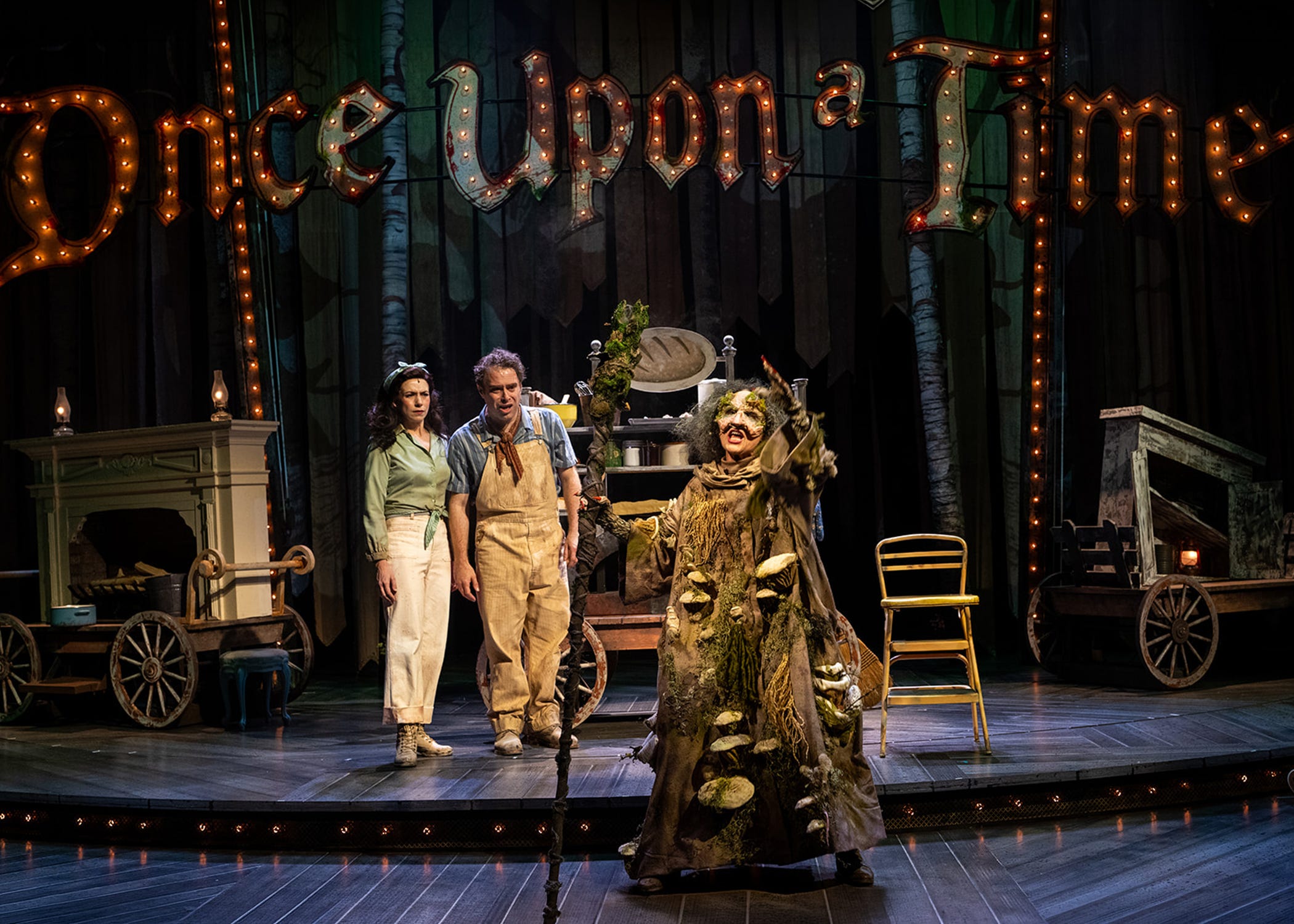
In Peter Rothstein’s lustrous staging of the Stephen Sondheim/James Lapine classic “Into the Woods” at South Coast Repertory in Costa Mesa, Act 2 is all too relevant amid the recent talk of possible “extinction” — especially during the most frightening song in the musical’s score, “The Last Midnight.” Valerie Perri, who sings it as the witch who has become a woman, creates serious chills.
Because of the current context, this revival of the fairy-tale mashup seems more of a comic tragedy than a tragic comedy. The entire cast is strong, but in the supporting cast, Michael Deni’s Prince (and Wolf) stands out; even his speaking voice has a resonant timbre. Among the sturdy survivors is musical director Wiley De Weese’s seven-piece backstage ban.
“Little Shop of Horrors,” at La Mirada Theatre, maintains a more consistently comic tone than “Into the Woods.” But note that the title’s final word is “Horrors”. If you don’t know the ending, here is a SPOILER WARNING: The tale ends with the distribution of leaf cuttings from the human-eating plant, Audrey II, all over America — and Audrey II’s descendants probably wouldn’t stop at national borders.
Michael Matthews’ staging of the Howard Ashman/Alan Menken musical pulses with comedic life, even as the plot veers toward lower-case apocalypse now. Grace Stockdale is hilarious as the human Audrey — for whom the monster was named — before it consumes her and everyone else. Jennifer Lin’s five-piece pit band escapes.
Back to the 20th century
Speaking of big-time musicals, the two most recent examples that arrived for their LA premieres, via tours at the Pantages Theatre in Hollywood, feature 20th-century young men who are orphans as the leading characters. This was probably a scheduling coincidence, not a concerted appeal to that particular demographic.
I’ll start with the more famous of the two, “The Outsiders,” which is playing at the Pantages now through October 18 and then at Segerstrom Hall in Costa Mesa through Nov. 1. It’s based on S.E. Hinton’s best-selling tale, about teenaged trouble between rival socio-economic groups of guys in Tulsa (this is more or less the anti-”Oklahoma!”). It was published in 1967, when Hinton herself was a teenager there. The protagonist’s oldest brother is his surrogate parent.
But “The Outsiders” is also a musical, with a book by Adam Rapp and Justin Levine and a haunting score by the Americana folk group Jamestown Revival (Jonathan Clay and Jack Chance) and the aforementioned Levine. The director, Danya Taymor, was the youngest woman to win the Tony award for directing a musical when she won for “The Outsiders,” and it won three additional Tonys, including best musical.
I attended a school-day matinee at the Pantages, and I was delighted to see that hundreds of middle/high schoolers — roughly the same ages as most of the characters — were sitting in the cheaper seats. Perhaps they had been reading Hinton’s original book in class, but whatever the cause, they sounded thrilled by the experience.
The other musical with an orphan protagonist, “Water for Elephants,” passed through the Pantages but will return to Greater LA at the Segerstrom in Costa Mesa for a November 10-22 engagement. It’s a behind-the-scenes circus melodrama set primarily during the Depression. With a score by Pig Pen Theatre, its gymnastic circus choreography reminded me of the days when the pre-Vegas Cirque du Soleil did its first US productions in LA. It features great animal puppetry. But Rick Elice’s book becomes overwritten to the point of confusion in the second act.
Catch it if you can
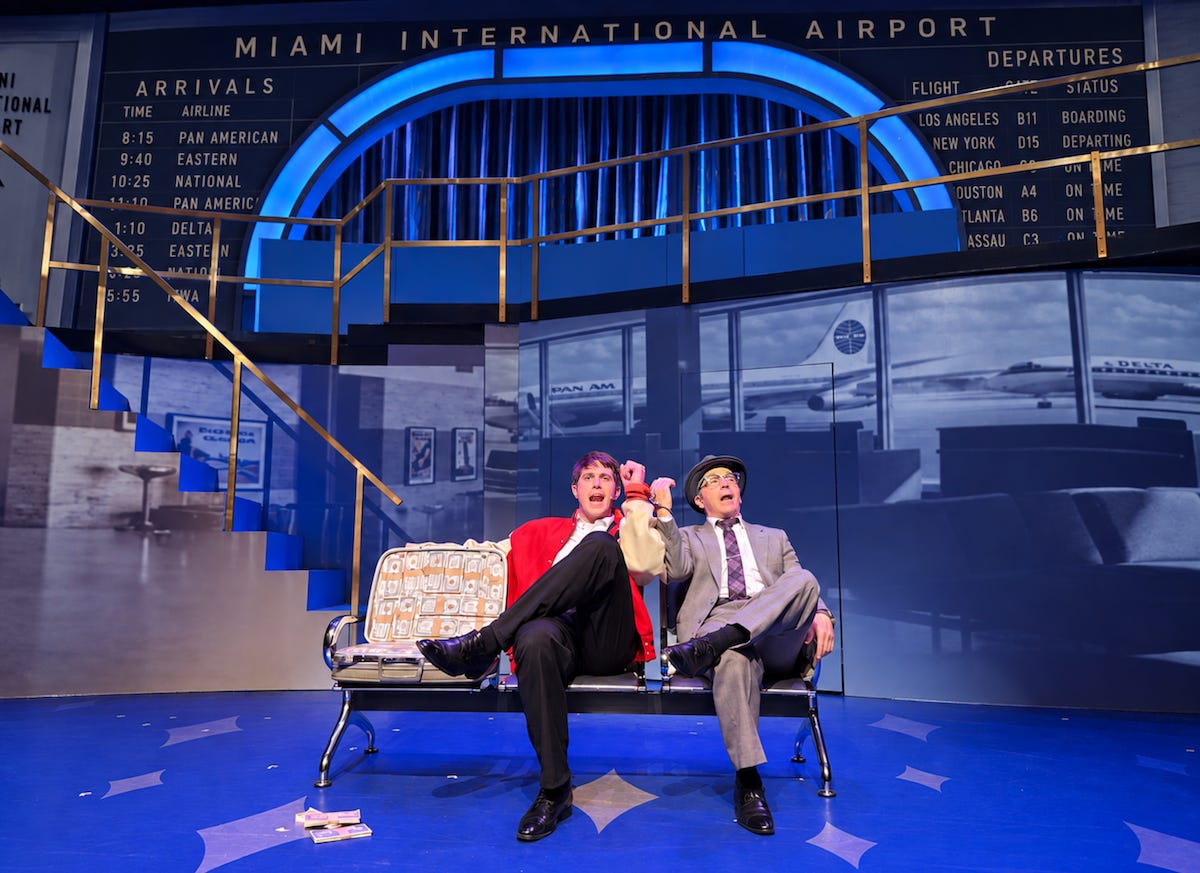
One additional musical that’s set in the 20th century is “Catch Me If You Can,” currently in a first-string revival at the mid-size Colony Theatre in Burbank. I’ve seen previous versions in much larger halls (as well as Steven Spielberg’s non-musical film version), but it really pops in this venue, where nearly everyone has a great seat.
It’s the story of the exceptionally crafty Frank Abagnale Jr., a young con artist who was active in the ‘60s and ‘70s. Terrence McNally wrote the book, with a score by Marc Shaiman and Scott Wittman. Michael Donovan’s staging features Blake Jenner’s convincing swindler and a flawless Joe Abraham as the determined agent who finally tracks him down. Kudos for Natalie Iscovich’s swingin’-60s choreography and Gabrieal Griego’s projections.
TV-related reunions
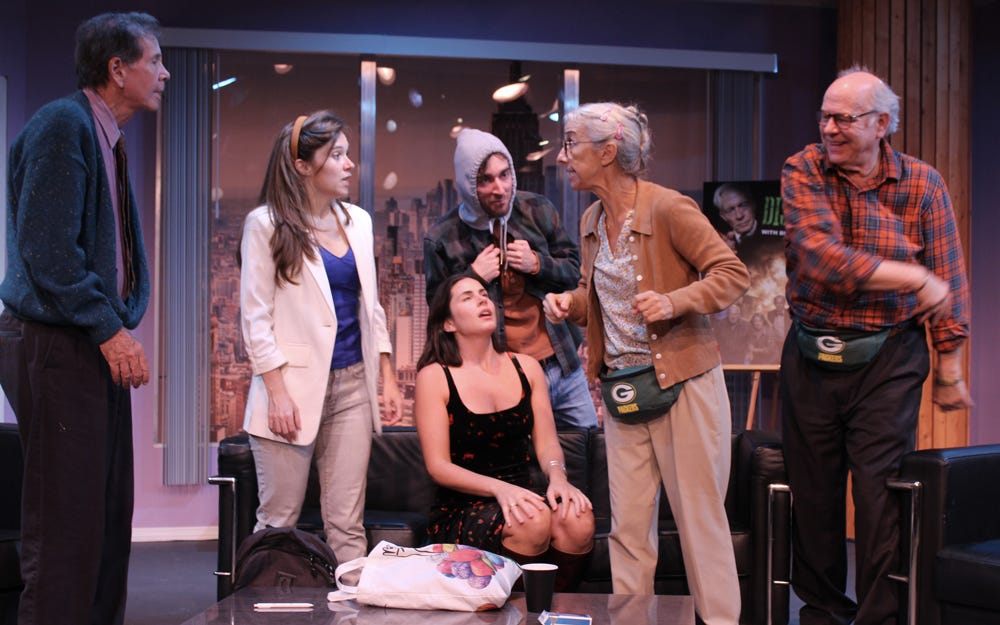
Yes, the title is ironic — “The Feel Good Story America Needs Right Now,” at Theatre West in the Cahuenga Pass. The title of Mark Wilding’s new play should not deter those of us who usually rely on “conflict” of some kind to interest us in plays. This play has “conflict” on steroids.
The setting is a Manhattan hotel suite as American ex-hostages who were finally released from confinement by terrorists in Sudan are gathering to appear, as a group, on a popular TV newsmagazine. One of them, a struggling journalist, has turned their harrowing experience into a book, the publication of which will coincide with their TV appearance.
The others are now reading the book’s galleys, as they prepare for their appearance. But as they read, they start telling the author that his accounts of their own particular ordeals are inaccurate. Eventually they’re so upset at his attitude that they gang up against the author to an extent that briefly suggests how they were treated by their captors. Meanwhile, the producer (Jill Remez) of the TV show grows increasingly impatient — with her junior assistant (Danielle Weeks) as well as with the ex-hostages.
I laughed out loud more than I have at any other recent comedy. The characters cover a wide range of ages and backgrounds. Charlie Mount’s staging is packed with risible moments and performances.
Janine Nabers’ “The Peterson Show,” an Echo Theater production in Atwater Village, depicts an LA reunion of actors who worked together on a sitcom that at least loosely resembles “The Cosby Show” — but the name “Cosby” is never mentioned, replaced by “Peterson.” Some of these characters have moved on very well since the show ended, but one of them is a conspicuous exception.
The first act could use some surgery. It’s very long, followed by a much shorter second act. The script doesn’t use stories of the real-life women who accused Cosby of sexual assault, preferring to suggest something that happened to a “Peterson Show” cast member. We hear the voice of “Peterson” but never see him. The scenic design is a confusing mess, which might have been clarified if two tiers were used.
Superlative Shaw
Of course sexual abuse of women has existed for…eons? It usually wasn’t discussed in polite society, but George Bernard Shaw broke that tradition with his 1893 play “Mrs. Warren’s Profession,” which was originally banned because its title character is a wealthy woman who runs a chain of brothels. It was first produced privately in 1902 and finally produced publicly in 1925.
Pacific Resident Theatre in Venice is doing a superb, up-close revival of this splendid play in a small space, directed by Michael Rothhaar. It features an actual mother and daughter — Cyndy Fujikawa and Nell Murphy, respectively — as the madam and her young-adult daughter, a Cambridge graduate who becomes informed not only of the source of the family wealth but also of the fact that her mother is still engaged in the same business. Both Fujikawa and Murphy have mastered every moment.
At LATC and the Getty
Briefly, I’ll note that tonight is the final performance of Latino Theater Company’s “Antigone in the Language of Kings,” adapted by Evelina Fernández from Sophocles’ Greek tragedy into a pre-conquest setting in Tenochtitlán (in what is now Mexico) at the Getty Villa in Pacific Palisades. This was probably the company’s largest spectacle ever, but unfortunately the website says tonight’s show is sold out.
Meanwhile, in the Latino Company’s home base in downtown LA, Artists at Play is presenting an early work by David Henry Hwang, “The Dance and the Railroad,” in the vertically challenging Theatre 2, near the lobby door. It’s a rather slight two-man one-act set in 1867, staged completely apart from the reported offstage action of a strike among the Chinese immigrant workers on the transcontinental railroad. Most of the elaborate set is never used.
And three smaller shows
The title “A Case for the Existence of God” perhaps sounds like a much bigger show, but the title is overblown. Directed by John Perrin Flynn in the tiny upstairs space of the Matrix on Melrose, Samuel Hunter’s script shows us two men — a real estate broker and his client — trying to arrange the purchase of a property in Twin Falls, Idaho. A final scene occurs in the future. I wasn’t sure that I understood that scene until I read the script; it might have been clearer if the play had been staged in the venue’s larger space (unlike the recently closed revival of Friedrich Dürrenmatt’s “The Visit,” at the Pasadena Playhouse, which might have benefited from a somewhat smaller space).
The first part of Dan Caffrey’s “Kaiju,” at Road Theatre in North Hollywood, is funny, as two giant but relatively amiable monsters trample over a model of not merely North Hollywood but also adjacent parts of LA as well, consuming the inhabitants and easily swatting down any attempts to stop them. Director Ken Sawyer’s design team features too many people to be mentioned here, but they have worked wonders in this small space. However, the play then devolves into a parody of a “post-play talkback” which isn’t nearly as interesting.
Finally, the story behind the Supreme Court’s 2003 affirmation of the right of same-sex couples to have consensual sex is dramatized in Howard Skora’s “Texas Sodomy: The Incredible True Story of Lawrence v. Texas,” at the Whitefire Theatre in Sherman Oaks. Of course it’s important and interesting. But the timespan of the play covers nearly five years, and it’s currently in an intermission-less format that lasts nearly two hours. Not every moment is essential. Drew Droege stars as Lawrence.